
A luxury suit costing over ten thousand dollars, or a silk dress you simply can’t bear to part with—what would you do if, after wearing them a few times, they developed a slight stain or started to smell of sweat? Quite a few people, for the sake of convenience or to save a few dozen dollars on laundry costs, simply throw them straight into the washing machine. The result is that the suit comes out shrunken and misshapen, whilst the silk dress feels stiff and has lost its colour. it really is a complete waste of time!
In everyday life, looking after your clothes is quite a science. Should a garment be ‘dry-cleaned’ or ‘hand-washed’? And what do all those strange symbols on the ‘care label’ inside the hem actually mean? Today, we at Sunny Professional Cleaning have put together the most comprehensive guide to garment care, teaching you how to understand all washing labels at a glance—with a special focus on the secrets to caring for expensive suits. We guarantee you’ll never wash your clothes the wrong way again!
What’s the difference between dry cleaning and wet cleaning, anyway?
Many people think that ‘dry cleaning’ simply involves using a vacuum cleaner to remove dust, or using dry powder to clean a garment; in fact, this is a huge misconception. The main difference between dry cleaning and wet cleaning lies inDifferent agents are used to dissolve stains.
1. Wet washing (Laundering)
As the name suggests, this method uses water as the primary cleaning agent, combined with liquid or powder detergent, to remove dirt through the mechanical agitation and friction of the washing machine.
- Advantages: It effectively removes water-soluble stains (such as sweat, fruit juice and mud), leaving a fresh scent after washing, and is suitable for underwear.
- Disadvantages: Water causes certain natural fibres (such as wool and silk) to swell. When wool fibres absorb water and swell, combined with the rotation of the washing machine, the scales on the fibre surfaces become interlocked, leading to severe shrinkage and pilling.
2. Dry Cleaning
Dry cleaning is actuallyIt’s definitely not dry! During the dry-cleaning process, garments are also tumbled around inside a large ‘washing machine’—only instead of water, it containsSpecially formulated dry-cleaning solvent.
- Principle: Dry-cleaning solvents can directly dissolve oil-soluble stains (such as sebum, make-up, paint and butter), and the solvent is not absorbed by the fibres of the garments.
- Advantages: As the fibres do not absorb water and swell, dry cleaning perfectly preserves the original shape, size and colour of garments. For garments that are prone to losing their shape, shrinking or have a complex structure (such as suits), dry cleaning is the only safe option.
Understand it all in a flash with this one image! A complete guide to common ‘care labels’
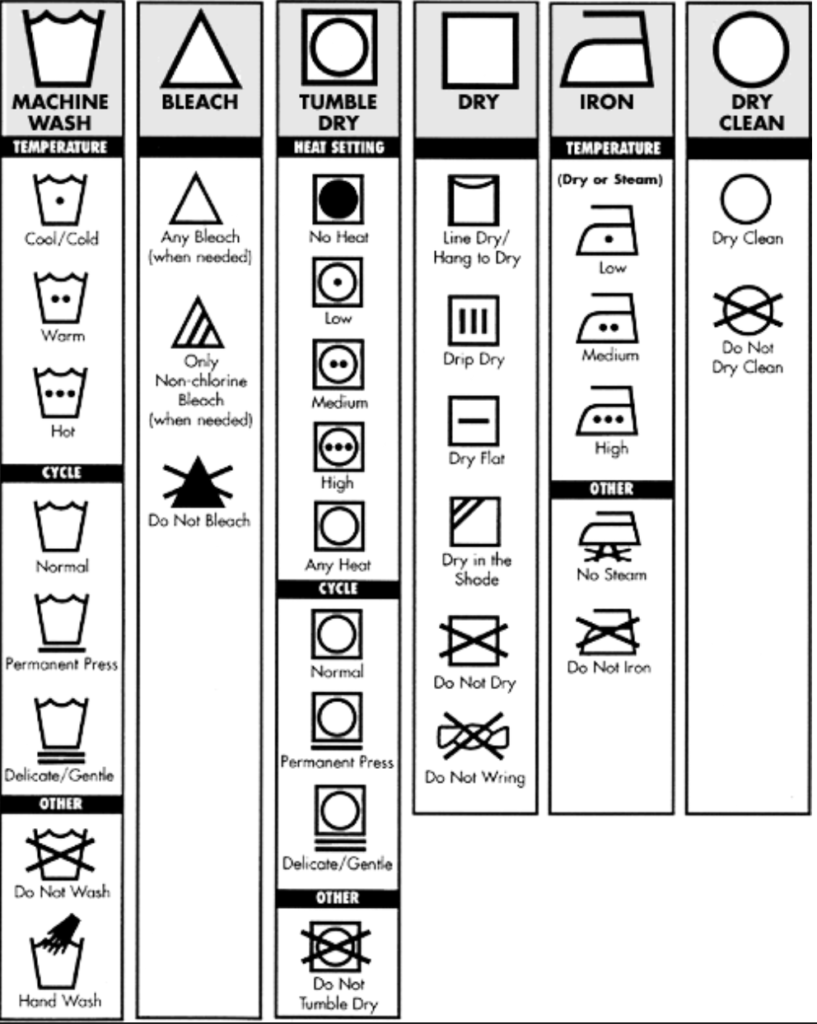
Whenever I buy a new item of clothing, there’s always a whole stack of labels on the inside, covered in all sorts of geometric symbols that make your head spin. In fact, internationally recognised care labels can be broadly divided into five main categories:Laundry basin, triangle, square, iron, circle. As long as you remember these five basic shapes, you’ll be well on your way to becoming a laundry expert.
1. Laundry basin (washing instructions)
The washing basin indicates that the garment is machine-washable.
- There are numbers or dots inside the bowl: Indicates the maximum water temperature limit. For example, if the label on the basin says ‘30’ or shows a single dot, this means it can only be washed in water up to 30°C; if there are two dots, it is usually 40°C.
- A horizontal line across the pelvic floor: A single horizontal line indicates that the ‘Gentle Cycle’ should be used; two horizontal lines indicate that the ‘Extra Gentle Cycle’ should be used, which means a slower spin speed.
- There’s a hand in the bowl: This item must be ‘hand washed’ only; please do not put it in the washing machine under any circumstances.
- The laundry tub was marked with a large cross: representativeNever wash with water! One dip in water and the shirt’s done for.
2. Triangle (bleach indicator)
- Hollow triangle: Any bleach can be used.
- There is a diagonal line inside the triangle: You must use ‘non-chlorine bleach’ (i.e. colour-safe bleach or oxygen bleach); do not use traditional chlorine-based bleach.
- A large cross is drawn over the triangle: The use of any bleaching agents is strictly prohibited.
3. Square (drying instructions)
There is a circle inside a square, indicating that the item is suitable for tumble drying.
- Dots inside a circle: One dot indicates low-temperature drying, two dots indicate medium temperature, and three dots indicate high temperature.
- A large cross is drawn over the square: Do not put it in the tumble dryer, as it will shrink significantly.
- A vertical or horizontal line within a square: Indicates natural drying methods. A vertical line indicates ‘Hang dry’; a horizontal line indicates ‘Dry flat’, which is usually used for jumpers to prevent them from losing their shape.
4. Iron (ironing instructions)
- There are some specks inside the iron: One dot indicates low-temperature ironing (approx. 110°C, suitable for silk/nylon); two dots indicate medium temperature (approx. 150°C, suitable for woollen fabrics); three dots indicate high temperature (approx. 200°C, suitable for cotton/linen).
- A cross has been drawn beneath the iron: Do not use steam; dry ironing only.
- The iron has been marked with a large cross: Do not iron.
5. Circle (dry-cleaning symbol) – The most important symbol!
- Hollow circle: It must be taken to a professional dry cleaner.
- There are English letters (A, P, F) inside the circles: This is intended for the dry cleaner’s staff and indicates which type of dry-cleaning solvent is suitable for use. For example, ‘P’ indicates that conventional solvents such as perchloroethylene may be used; ‘F’ indicates that only petroleum-based hydrocarbon solvents may be used, which are gentler on garments.
- A large cross has been drawn through the circle: Do not dry clean.
Why is it that expensive suits ‘must never, ever be washed’?
Lots of guests have come Sunny Pro Clean Help! I’ve washed my Armani or bespoke suit—which cost several thousand or even over ten thousand dollars—in the washing machine, and now it’s all lumpy, with the collar all puffed up; it’s completely unwearable. Why are suits so delicate?
To understand this, you first need to understand the ‘internal structure’ of a suit. A well-structured, stylish suit jacket is not simply the fabric on the outside; it is actually full of clever details on the inside:
- Interlining and Fusing:To ensure that the chest and lapel areas of a suit remain crisp and structured, tailors insert ‘fleece’ or ‘fused interfacing’ between the outer fabric and the lining. In the case of fused interlining, exposure to water and the high temperatures and agitation of a washing machine can cause the adhesive to dissolve and fail, resulting in the outer fabric and interlining separating, and an uneven, ‘bubbling’ effect appearing on the surface. This type of damage isIrreversibleWell, not even a god could save him.
- Shoulder Pads:Shoulder pads are usually made of cotton, foam or felt. Washing causes the shoulder pads to absorb water and become heavier, whilst the centrifugal force during the spin cycle distorts and deforms them, resulting in the suit having uneven shoulders.
- Pure wool (100% Wool):Most high-end suits are made from pure wool with a high yarn count (such as Super 110s or 130s). Wool fibres have scales on their surface; when soaked in water, these scales open up and interlock, causing the entire suit to shrink significantly – it may shrink from a size L to an S.
So, no matter how much body odour your suit has absorbed, itUnder no circumstances should it be washed with water. The correct way to do this is to hang the suit in a well-ventilated area to allow the sweat to dry, and then take it to a professional dry cleaner.
Which fabrics must be dry-cleaned? Which ones can I wash myself?
To help you avoid any pitfalls, we’ve put together a simple material comparison chart:
🚨 Strongly recommended / Must be dry-cleaned:
- Wool / Cashmere: It is highly prone to shrinkage and distortion.
- Silk: Washing can easily cause the fabric to lose its lustre, fade in colour and become stiff.
- Velvet: Washing will damage the pile texture on the surface, rendering the garment unusable.
- Leather / Suede: Water draws out the natural oils from the leather, causing it to crack and become stiff.
- Garments with complex structures: Blazers, pleated skirts, evening dresses, and garments featuring extensive sequins or embroidery.
✅ Materials that are safe to wash:
- Pure cotton (Cotton): For example, T-shirts and shirts (with the exception of some high-end crease-resistant shirts).
- Linen: Although it creases easily, it is machine washable (do not use water that is too hot).
- Polyester / Nylon: Synthetic fibres are highly resistant to washing and do not lose their shape easily.
- Denim: It is machine washable, but to preserve the colour and shape, we recommend washing it inside out and minimising the number of washes as much as possible.
How does Sunny Professional Cleaning help you look after your favourite clothes?
When entrusting your favourite garments to someone else, the biggest fear is that they might be damaged or not cleaned properly. We fully understand the value behind every beautiful garment. Our professional team will provide the very best care for your clothes:
- Carefully assess the situation before washing: Our experts will first carry out a thorough inspection of the garment’s care label, fabric composition and the type of stain (oil-based, water-based or a mixture of both), before devising a bespoke cleaning solution that is best suited to the garment.
- Professional Hand-Based Stain Removal (Spotting): Dry cleaning is not a cure-all; some stubborn stains (such as red wine, coffee and blood) require spot treatment by hand using specialised chemical stain removers applied by an experienced specialist before the garment is put through the machine.
- High-quality, environmentally friendly solvents: We use high-quality dry-cleaning solvents that comply with international standards; they are highly effective at removing stains whilst protecting the fibres of your garments, and leave no pungent chemical odour after cleaning.
- Masterful Hand Pressing: The soul of a suit lies in its ‘cut’. We use professional mannequins and steam irons, combined with the skilled hands of our tailors, to restore the suit’s perfect three-dimensional cut, ensuring the lapels maintain a natural, upright curve.
In summary: Take good care of your nice clothes and take them to a professional dry cleaner’s.
Having read this article, I’m sure you now have a thorough understanding of ‘dry cleaning’ and ‘wet cleaning’, and know how to interpret those complicated care labels. Remember, looking after your clothes is just like looking after your skin – using the wrong methods will only accelerate ageing and damage.
When it comes to expensive suits, silk dresses or garments with sentimental value, please do not take any chances by putting them in the washing machine. Leave the job to the experts – Sunny Professional Cleaning is always ready to provide you with the most reliable laundry service. Visit our website now to book our collection and delivery service, and let us help your clothes look as good as new!
Frequently Asked Questions (FAQ) on Dry Cleaning and Wet Cleaning
Q1: Will the clothes have a strong chemical smell after dry cleaning?
A: A high-quality, modern dry cleaner will use solvents that meet high safety standards and ensure that the dry cleaning machine’s filtration and drying recovery systems are in good working order. Under normal circumstances, washed garments will have only a very faint odour, if any at all. If there is a strong, pungent chemical smell, this is usually due to the dry cleaner failing to replace filters regularly or the solvent having gone off.
Q2: If the label says ‘Dry Clean Only’, does that mean it absolutely must not come into contact with water?
A: In most cases, when manufacturers label an item ‘Dry Clean Only’, it is to absolve themselves of liability and ensure that the garment will absolutely not lose its shape as a result of washing. Although a very small number of high-quality fabrics (such as certain silk blends) can be carefully hand-washed by highly experienced individuals, to be on the safe side, it is strongly recommended that you follow the care label instructions, particularly for suits and overcoats with complex constructions.
Q3: How often should I take my suit to the dry cleaners?
A: You shouldn’t have items dry-cleaned too often, as excessive dry-cleaning can accelerate fibre ageing and cause the fabric to lose its lustre. General advice:
- Regular exercise (2–3 times a week): Dry clean 1–2 times per season.
- Occasional wear (for special occasions): Once you have finished wearing it, if there are no obvious stains, brush off any dust with a soft-bristled brush, hang it up in a well-ventilated place to air-dry, and have it dry-cleaned once a year before storing it in your wardrobe. If there are any localised stains, have it cleaned as soon as possible; do not wait several months before dealing with them.
Q4: Can dry cleaning remove all stains?
A: No, you can’t. Dry-cleaning solvents are very effective against ‘oil-based stains’ (such as grease, make-up and ballpoint pen ink); however, they are less effective against ‘water-based stains’ (such as sweat, alcohol and fruit juice). Therefore, when taking your clothes to the dry cleaner’s, you must make a point of telling them the source of the stains so that the staff can carry out targeted spot treatment before dry cleaning.
Q5: What should I do if there is no care label on the shirt, or if the label has been cut off?
A: This is where a laundry specialist’s experience really comes into its own. Professional dry cleaners can identify the fabric by feeling its texture, observing the lustre of the fibres and, if necessary, carrying out a burn test. If there is any uncertainty, a gentle dry-cleaning or an extremely gentle hand-wash treatment is usually chosen as a precaution. You can rest assured by entrusting the assessment to the professional team at Sunny Professional Cleaning.